
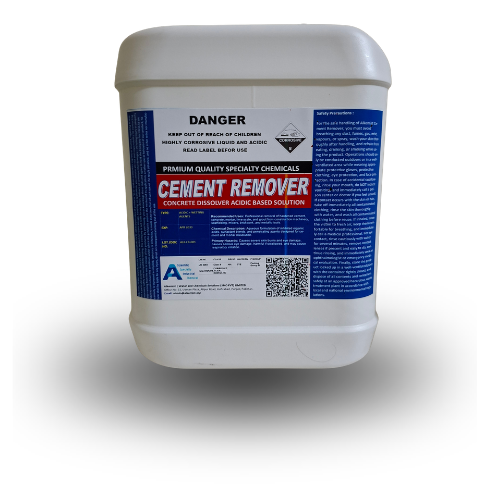


ALKEMIST Cement Remover is a laboratory and industrial grade chemical reagent supplied by Alkemist | Water and Chemicals Solutions (SMC-PVT) LIMITED under the ALKEMIST™ brand.
Technical Specifications
| Chemical Name | ALKEMIST Cement Remover |
|---|---|
| Chemical Formula | N/A |
| CAS Registry Number | N/A |
| Brand | ALKEMIST™ |
| Supplier | Alkemist | Water and Chemicals Solutions (SMC-PVT) LIMITED |
| Availability | In Stock (Nationwide Delivery in Pakistan) |
Properties & Applications
Standard laboratory and industrial grade applications.
Safety & Handling Information
Safety Precaution: Handle in accordance with Good Laboratory Practices and consult the Safety Data Sheet (SDS) prior to use.
ALKEMIST™ Cement Remover & Concrete Matrix Dissolver
ALKEMIST™ Cement Remover is a professional industrial chemical formulation engineered for demanding marine, shipyard, construction, and post-construction cleaning operations. Its concentrated low-pH mineral-dissolving technology penetrates and chemically breaks down hardened cementitious and mineral contamination that conventional alkaline detergents and general-purpose cleaners cannot efficiently resolve.
This solution is formulated to eliminate cement splashes, mortar residue, grout haze, concrete incrustations, mineral scale, rust staining, and heavy alkaline inorganic deposits from compatible substrates. The integrated surfactant and wetting matrix ensures sustained surface contact with stubborn encrustations, significantly reducing mechanical scraping and overall cleaning cycle times.
Designed for construction contractors, industrial maintenance teams, shipyards, marine repair facilities, and technical cleaning specialists, the concentrated chemical profile allows precise dilution tailored to deposit thickness and site requirements.
Key Benefits & Performance Advantages
- Minimizes Manual Abrasion: Chemically disintegrates hardened cementitious bonding, cutting labor-intensive chiseling and scraping.
- Accelerates Project Turnaround: Rapidly clears tough post-construction overspray, wash water residue, and masonry spillages.
- Broad Mineral Reactivity: Highly effective against alkaline scale, lime build-up, and metal oxidation staining.
- Marine & Industrial Grade: Engineered specifically for rugged plant, vessel, and infrastructure maintenance regimens.
- Economical Concentrate: Easily titrated and diluted on-site based on deposit severity.
Typical Physical Properties
| Appearance | Clear to Pale Yellow Liquid |
| Odor | Characteristic Pungent Chemical Odor |
| Chemical Class | Inorganic Low-pH Mineral Dissolver |
| pH Profile | Strongly Low-pH / Highly Active Reaction Index |
| Solubility | Complete in Water |
| Flammability | Non-Flammable |
| Application Grade | Industrial / Professional Grade Only |
Recommended Dilution Rates
- Light Cement Haze & Thin Mineral Films: Dilute 1 part chemical to 10 parts clean water (1:10).
- Moderate Mortar Splatters & Grout Encrustation: Dilute 1 part chemical to 5 parts clean water (1:5).
- Heavy Concrete Buildup & Industrial Crusts: Mix 1 part chemical to 2 or 3 parts water (1:2 to 1:3), subject to substrate compatibility and trials.
- Dilution Safety Protocol: Always add the concentrated chemical slowly into water. Never introduce water directly into concentrated solution to prevent thermal spattering.
Detailed Application Method & Standard Operating Procedure
-
Surface Evaluation & Substrate Testing:
Confirm that the target surface is chemically non-reactive to low-pH formulations. Conduct a spot test on an isolated or inconspicuous area. Do not use on zinc, galvanized steel, raw aluminum, non-ferrous soft alloys, marble, limestone, or delicate decorative polished finishes. -
Pre-Wetting Porous Surfaces:
Prior to chemical application on porous masonry, brick, or unglazed tiles, pre-soak the surface thoroughly with clean water. This prevents the chemical from drawing deep into the substrate and focuses the active chemistry exclusively on the surface deposits. -
Chemical Application:
Apply the prepared dilution evenly using a low-pressure chemical-resistant sprayer, low-pressure applicator, synthetic bristle brush, or acid-proof sponge. Work systematically from lower areas upward on vertical walls to avoid streak formation. -
Reaction Dwell Time & Mechanical Agitation:
Allow the active chemistry to dwell on the contamination for 5 to 15 minutes. The chemical will actively react and effervesce as it decomposes carbonate binders. While wet, agitate stubborn deposits with a stiff-bristle nylon brush to break mechanical keying. Do not allow the solution to dry completely on the substrate. -
High-Pressure Wash & Neutralization:
Flush the treated area thoroughly with high-pressure freshwater to lift emulsified sludge and dissolved mineral salts. On sensitive industrial floors or marine steel decks, perform a secondary rinse with a mild alkaline wash (e.g., dilute soda ash solution) to restore a neutral surface pH before final water rinsing. -
Marine & Shipyard Protocols:
When operating in vessel hulls, dry docks, or confined maritime spaces, maintain continuous forced ventilation, enforce strict PPE protocols, collect wash water in compliance with local environmental discharge regulations, and complete thorough potable-water flushes.