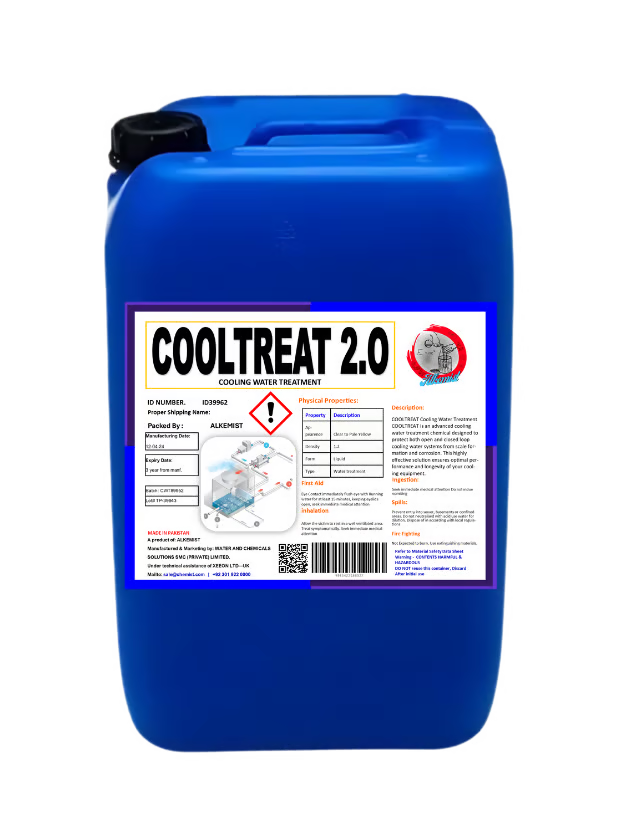
Cooling & Chilled Water Product Pages
Use these links to explore each chemical and request a quotation.
Need boiler water programs too? Visit our boiler master page and product links.
Cooling Water Treatment Theory
Cooling systems fail for three main reasons: corrosion, scale/deposits, and biofouling. Treatment is not only chemicals—it's also monitoring, bleed control (for towers), filtration, and good operational practices.
Oxygen, low pH, salts, and microbiology can increase corrosion. Programs use inhibitors + stable conditions to reduce risk (program dependent).
- Common in: carbon steel, copper, mixed-metal loops
- Symptoms: rust, pinholes, high iron, under-deposit attack
Hardness, alkalinity, and high cycles in towers can form scale. Dispersants help keep particulates suspended and reduce deposits (program dependent).
- Common scale: calcium carbonate, silica, phosphates (site dependent)
- Symptoms: higher energy cost, hot spots, fouled exchangers
Warm water + nutrients can cause microbial growth, leading to slime, odor, and under-deposit corrosion. Biocides support control (program dependent).
- Common in: cooling towers, open sumps, dead legs
- Symptoms: slime, blocked nozzles, high bacterial counts
This page is educational. Final chemical selection, targets, and dosing depend on your system and must follow current SDS/TDS and site procedures.
Recommended Program Structure
A simple framework used for many sites (program dependent).
Identify system type (tower vs closed loop), metallurgy, operating temperatures, and pain points.
Use makeup water and circulating water readings (pH, conductivity/TDS, hardness/alkalinity) and any microbiological checks.
Set dosing points, sampling schedule, and KPIs. Trend readings and adjust based on performance (program dependent).
In open cooling towers, uncontrolled cycles and poor blowdown control are a common cause of scale and biofouling. In closed loops, frequent top-ups dilute inhibitors and reduce protection.
Technical Details (Practical)
Use these practical points when discussing your system with our chemist team.
- System type: open tower vs closed chilled loop (oxygen and evaporation differ a lot).
- Makeup water quality: hardness/alkalinity and TDS drive scale risk and cycles.
- Metallurgy: carbon steel/copper/aluminum/stainless require compatible chemistry.
- Operating temperature: affects corrosion rates and microbial growth potential.
- Hydraulics: dead legs and low-flow zones increase deposits and biofilm risks.
- City + industry + system type (tower/loop)
- System volume (m³) + makeup rate (if tower)
- Water analysis: pH, conductivity/TDS, hardness, alkalinity
- Issues: scale, corrosion leaks, slime/biofilm, fouling
- Photos of basins/heat exchangers (optional)
All dosing and targets are program dependent. Always follow current SDS/TDS and site procedures. If you need a documented plan, request a quotation with your system details.
FAQs
Quick answers for plant teams across Pakistan.
What is cooling water treatment?▾
Cooling water treatment is a managed program that controls corrosion, scale, and biological growth in cooling systems using chemistry, monitoring, and operational best practices.
What is the difference between cooling tower (open) and chilled water (closed-loop) systems?▾
Open recirculating systems (cooling towers) lose water by evaporation and need makeup water; they are more prone to scale and biological growth. Closed-loop chilled water systems are mostly sealed and commonly focus on corrosion control and long-term stability.
Which chemicals are commonly used in cooling water programs?▾
Programs often include corrosion inhibitors, dispersants, scale control, pH/alkalinity adjustment, and biocides for microbial control. Exact selection depends on water quality, metallurgy, temperature, and system type.
Do you supply cooling water treatment chemicals across Pakistan?▾
Yes. Alkemist supplies across Pakistan including Punjab, Sindh, KPK, Balochistan, ICT, AJK, and Gilgit-Baltistan (logistics dependent).
What information is needed for a quotation?▾
System type (tower/chilled loop), volume, metallurgy, operating temperature, makeup water source and analysis (pH, TDS/conductivity, hardness/alkalinity), and current issues (scale, corrosion, slime, biofilm, fouling).
Request Quotation
Tell us your system type and water quality. We will recommend a program approach (quotation based).